Can My House Support a 22kW EV Charger?
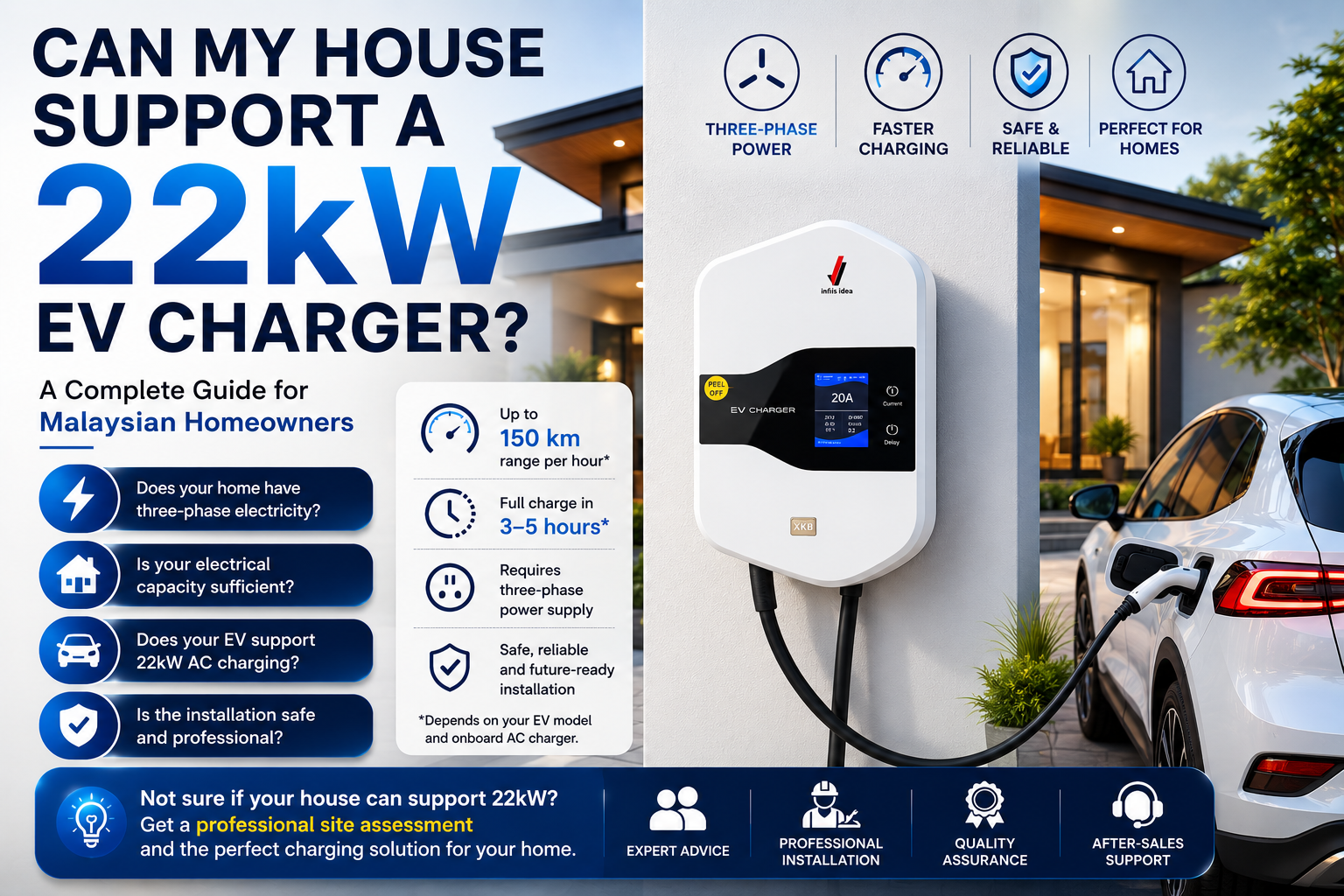
As more Malaysians switch to electric vehicles (EVs), one of the most common questions homeowners ask is:
"Can my house support a 22kW EV charger?"
The short answer is yes—but not every home is ready for one. The answer depends on your home's electrical supply, your daily charging needs, and the condition of your electrical installation.
Let's explore what you need to know before deciding on a 22kW home EV charger.
What Is a 22kW EV Charger?
A 22kW charger is a three-phase AC EV charger designed to deliver significantly faster charging than a standard 7kW single-phase charger.
Under ideal conditions, a 22kW charger can provide approximately:
- Up to 120–150 km of driving range per hour of charging (vehicle dependent)
- A full charge for many EVs in around 3–5 hours
However, the actual charging speed is determined by your vehicle's onboard AC charger. If your EV only supports 7kW or 11kW AC charging, it will charge at that maximum rate even when connected to a 22kW charger.
Step 1: Does Your Home Have Three-Phase Electricity?
This is the most important requirement.
A 22kW AC charger requires:
- Three-phase electrical supply (400V)
- Adequate incoming electrical capacity
- Proper circuit protection
- Professional installation
Many newer landed homes in Malaysia already have three-phase power, while older homes and most apartments commonly have only a single-phase supply.
If your property has only single-phase electricity, a 22kW charger cannot operate at its full capacity.
Step 2: Is Your Electrical Capacity Sufficient?
Even if your home has three-phase electricity, you need enough available electrical capacity.
Consider other appliances that may be operating at the same time:
- Air conditioners
- Water heaters
- Ovens
- Induction cooktops
- Washing machines
- Clothes dryers
- Swimming pool pumps
- Home lifts
When these appliances operate simultaneously with a high-power EV charger, your home's electrical load can increase substantially.
A professional load assessment ensures your electrical system can safely support EV charging without unnecessary risk.
Step 3: Does Your EV Support 22kW AC Charging?
Many EV owners are surprised to learn that not every electric vehicle can charge at 22kW AC.
The limiting factor is the vehicle's onboard AC charger.
For example:
- Some EVs support only 7kW AC charging
- Many modern EVs support 11kW AC charging
- Only selected models support the full 22kW AC charging capability
Installing a 22kW charger does not automatically mean your vehicle will charge at 22kW.
Before purchasing, always verify your vehicle's AC charging specification.
Step 4: Do You Really Need 22kW?
Faster is not always better.
Ask yourself:
- How many kilometres do you drive each day?
- How many hours is your car parked overnight?
- How quickly do you need a full charge?
For many homeowners who drive 40–80 km daily, a 7kW charger is often more than sufficient, as it can fully recharge the vehicle overnight.
A 22kW charger becomes more beneficial if:
- Your household owns multiple EVs.
- You drive long distances every day.
- You need rapid top-up charging between trips.
- Your vehicle supports higher AC charging speeds.
The right charger is the one that matches your lifestyle—not simply the one with the highest power rating.
Step 5: Safety Should Always Come First
A home EV charger is a high-power electrical appliance and should never be installed without proper planning.
A professional installation typically includes:
- Dedicated EV charging circuit
- Correct cable sizing
- Appropriate circuit breakers
- Residual current protection
- Proper earthing
- Testing and commissioning
- Compliance with local electrical standards
Choosing a qualified installer helps ensure safe, reliable operation for years to come.
Future-Proofing Your Home
If you're planning to upgrade your electrical supply or expect to own additional EVs in the future, installing a 22kW-compatible charging system today may be a worthwhile investment.
Even if your current EV charges at only 11kW, a correctly designed installation can help accommodate future vehicles that support higher charging rates.
The Importance of a Professional Site Assessment
Every home is different.
Before recommending a charger, a professional installer should evaluate:
- Existing electrical supply
- Main distribution board
- Cable routing
- Charger mounting location
- Available electrical capacity
- Future expansion requirements
A site assessment ensures you receive a charging solution tailored to your home's electrical system rather than a one-size-fits-all recommendation.
Final Thoughts
A 22kW EV charger offers fast and convenient home charging but only when your home and vehicle are compatible.
Before making your decision, consider:
- Does your home have three-phase electricity?
- Is there sufficient electrical capacity?
- Does your EV support 22kW AC charging?
- Do your daily driving habits justify the additional charging power?
- Has a qualified installer assessed your home's electrical system?
By answering these questions, you can choose a charging solution that is safe, efficient, and ready to support your EV ownership for years to come.
If you're unsure which charger is right for your home, consult an experienced EV charging specialist INFIUS IDEA who can perform a professional site assessment and recommend the most suitable solution based on your property's electrical infrastructure and your driving needs.